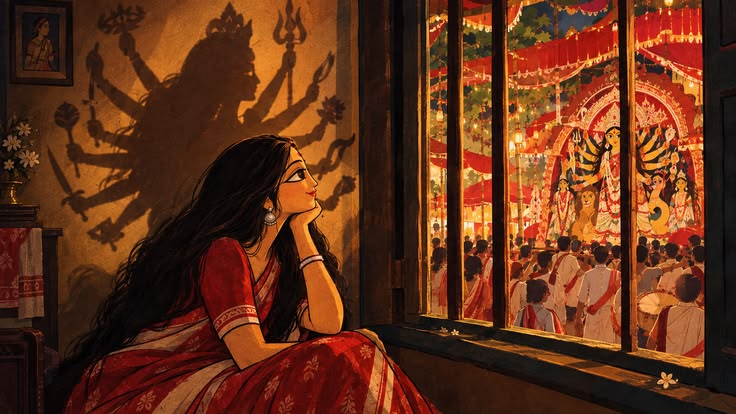
This week, a large part of India is doing the same thing in a hundred different ways, and it has a lot to teach us about finding clarity in midlife.
Navratri began on 11 October and runs through the 19th, with Vijayadashami on the 20th. In the east, the pandals are coming alive for Durga Puja. Whereas in the north and west, people are fasting, dancing, and getting ready to watch Ravan burn. And in the south, families are climbing out the old dolls and arranging them on steps.
Different cities, different sounds, different food. One goddess. One idea underneath it all: that good, eventually, wins.
I’ve been thinking about this all week, and not because of religion exactly. I’ve been thinking about it because I keep meeting people in their late twenties and early thirties, who are quietly asking the same question, the one at the heart of every midlife crisis: is this it? Is this what the middle of life feels like?
I think Navratri has a gentler answer than the one we usually give ourselves.
One Goddess, Many Ways of Worshipping
In Bengal and the east, Durga Puja is less a prayer and more a homecoming. Durga arrives like a daughter visiting her parents’ home, and the whole city stays up to welcome her. The dhak drums, the pandals built like art installations, the sindoor khela on the last day, and then the heavy, tearful goodbye at immersion. It’s tender and communal and loud.

In the north and west, the same nine nights look different. People fast. They observe the nine forms of the goddess one by one. In Gujarat, the nights fill with Garba and Dandiya. Elsewhere, Ramlila performances conclude with Ravan being set ablaze. It’s disciplined, rhythmic, and very physical.
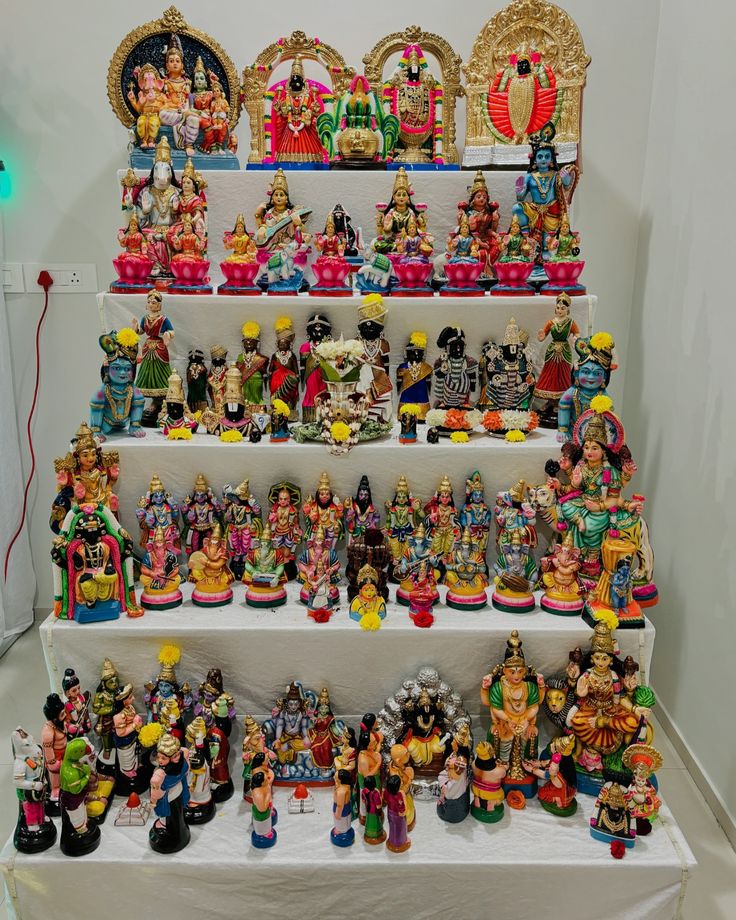
In the south, the mood turns quieter and more domestic. Karnataka and Tamil Nadu witness families setting up Golu, a display of dolls on odd-numbered steps, many of them passed down through generations. In Telangana, women stack flowers into Bathukamma, a festival that celebrates the goddess Durga. Karnataka has the royal Mysuru Dasara, and across Kerala and Karnataka, Ayudha Puja honours the tools you work with. On Vijayadashami, Kerala has Vidyarambham, when small children write their very first letters, a beginning blessed on a day of victory.
Nobody in Kolkata tells the family in Chennai they’re doing it wrong. Nobody in Ahmedabad says the Golu steps should have been a Garba circle. Everyone understands, without anyone saying it, that these are all the same worship, shaped by different soil.
Finding Clarity in Midlife Works the Same Way
That’s what I wish we remembered about being in different stages of life.
Every one of us is doing the same thing: living one life, for the first and only time. We just happen to be at different points in it. The twenty-two-year-old panicking about a first job, the thirty-five-year-old wondering if the career they built is the one they wanted, and the fifty-year-old watching their parents age and their children leave. Same effort. Different step on the staircase.
And here’s the thing nobody says out loud: whatever stage you’re in right now is brand new for you. Your parents may have been through their forties before, but not your forties, in your economy, with your phone, your rent, and your family structure. Nobody has lived this exact version before. So of course, it feels unmapped.
The crisis, if we want to call it that, often isn’t that something has gone wrong. It’s that we expected a map that never existed. Finding clarity in midlife begins when we stop waiting for that map to arrive.
What to Keep from the Generation Before Us
Here’s where I’d like to be careful, because this stage is the part we usually get wrong in one of two ways.
Some of us copy our parents’ generation entirely, because that’s the only blueprint we saw. Others reject it entirely because parts of it hurt, and it feels safer to call it all outdated.
Bombe Habba teaches a better way. Those dolls didn’t appear out of nowhere. They were handed down; some are decades old, and every year a family chooses which ones to bring out, which to retire, and which new ones to add. Nobody throws the whole collection away. Everyone is willing to add something.
So when I look at the generation before us, I try to ask a quieter question: what were they actually trying to do?
Their intention was often right, even when the method no longer fits. A parent pushing you toward a government job wasn’t being controlling for fun. They were trying to protect you from the kind of uncertainty they’d survived. That intention (safety) is still worth honouring. The method (one stable job for life) may simply not survive in today’s world. I wrote about a version of this in Rent or Buy, where the belief that you must own a house wasn’t wrong, but it came from a time with different prices and different expectations.
So here’s a small exercise. Take a page and draw two columns.
- In the first, write what your parents’ generation did well at your age: the discipline, the saving, the showing up for people, the quiet resilience, the habit of finishing what they started.
- In the second, write what they did out of fear or limited choice, which the world has since outgrown: the silence about money or feelings, the rigid timelines, the idea that you must suffer to deserve rest.
Then take the first column home like family heirlooms. Put the second one down gently, without calling anyone a villain. You can thank a belief for protecting someone, and still not carry it forward.
The Darkest Night is Followed by Light
There’s one more thing I love about how Navratri is built.
The seventh night honours Kalaratri, the darkest, fiercest form of the goddess. And the very next day, the eighth, is dedicated to Mahagauri, serene, luminous, radiant. The tradition places the darkest night right before the brightest day, on purpose.
I reflect on that when a midlife crisis feels heavy. When the questions stop being exciting and start being tiring. When you do everything “right” and still feel an unnamed ache. That heaviness isn’t proof you’ve failed. It may simply be your seventh night. Finding clarity in midlife doesn’t usually happen as a sudden lightning bolt. It arrives as Navratri does, one night at a time, and then, somewhere around the ninth or tenth, you notice the light has changed.
A Few Small Ways of Finding Clarity in Midlife, One Night at a Time
- Ask someone older what they were afraid of at your age. Not what they achieved, but what scared them. You’ll be surprised how often the answer sounds exactly like yours.
- Protect one quiet hour. Clarity rarely shows up in a loud, crowded mind. If you want a gentle place to start, slow mornings are a good one, and they work at 45 just as well as at 25.
- Begin something small, like Vidyarambham. Learn one new thing badly, on purpose. Beginnings don’t have an age limit.
- Stop comparing stages. Someone else’s Durga Puja isn’t a comparison with your Bombe Habba. They’re both ways to worship.
- Change the scenery. A few days somewhere with an open sky does what a hundred journal entries can’t. If you’re looking, my Garhwal or Kumaon piece might point you somewhere.
What Victory Actually Looks Like
Every year, on Vijayadashami, the story is that good wins over evil. I used to read that as a story about outside enemies.
Now I read it a little differently. In most of our lives, the “evil” isn’t the society or our past. It’s quieter: the fear we inherited without examining, the comparison we picked up from a feed, and the numbness we mistake for adulthood. The victory isn’t dramatic. It’s the day you notice you’ve chosen something deliberately, instead of by default.
So this week, as the drums, the dandiya sticks, and the little dolls on their steps remind us that the same love can look entirely different from one home to the next, I’d like you to offer the same permission to your heart. Your middle doesn’t have to look like your parents’, your friend’s, or the one you imagined at twenty. It just has to be honestly yours.
If you’re finding clarity in midlife, which stage are you in, and what’s one thing from the generation before you that you’d gladly carry forward?
I’d love to hear it in the comments!!
Leave a Reply