Be honest: how many times this week have you scrolled past a headline about war, AI, heat or interest rates and thought, “I should probably understand that, but I just can’t right now”?
Same here.
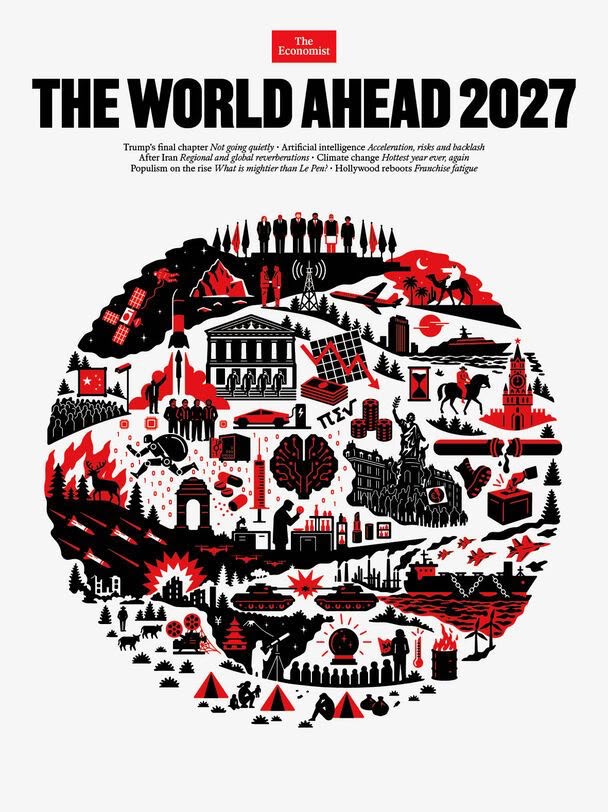
Then I saw the cover of The Economist’s yearly forecast issue, The World Ahead 2027 [1], and I couldn’t scroll past it. It’s a black-and-red circle, like a tiny planet, crammed with little pictures: rockets, wildfires, a huge brain, a ballot box, tanks, tents, a film projector. They all share one space.
And I thought, that’s exactly what being in your quarter life feels like. Not one big story. Everything, at once.
So I did what I do when something feels too big: I slowed down, read the actual reports, and wrote down what I could verify. If you’ve been wondering what to expect in 2027, and whether you should be worried, here’s a quick explanation.
TL;DR
- What to expect in 2027, in one line: a bumpy but still-growing year that’s hotter, more connected and more uncertain than most.
- The big themes: AI (growth and risk), a likely record-hot year, higher government borrowing costs, the aftermath of the Iran conflict, and elections like France’s.
- India: the IMF projected about 6.4% growth for FY27 and 6.7% for FY28 [4]. That’s still among the fastest in the world.
- Forecasts are educated guesses, not fate. Plan for a range of outcomes.
- You can’t control headlines. You can control your savings buffer, your skills and where your attention goes.
First, what’s actually on that cover?
I want to describe it in my own words, since the artwork belongs to the artist and The Economist. The cover’s printed headlines mention Trump’s final chapter perhaps, AI (acceleration, risks and backlash), what comes after the Iran conflict, a hottest-year-ever climate story, populism on the rise, and Hollywood’s franchise fatigue [1].
Here’s what I saw as my eye went around the circle:
- Top: a row of suited figures on a ridge, small against the landscape. Power, lined up.
- Top left: a satellite and a rocket trailing red flame. The space race is back, now with private companies.
- Top right: a camel under a crescent moon, a warship, a plane and an hourglass. West Asia, trade routes, and time running.
- Right: a tall Kremlin-style tower with a rider on horseback, and a ballot box beside a statue and crowd. Old power and new elections, side by side.
- Centre: a big, glowing brain surrounded by chips, binary code, a syringe and pills. AI and medicine, right at the heart of things.
- Falling red chart, coins, cash, an electric car at a charger: the economy, nervous and changing.
- Left: wildfires with a deer running from them, missiles, an explosion and drones. A thermometer and a burning barrel sit lower down.
- Bottom: tanks, a tanker ship, a broken pipeline dripping oil, a telescope, a crystal ball with a crowd around it, and tents, with one person sitting alone, head in hands.
- Bottom left: a film projector. Hollywood, in its quiet corner.
(I’ve hedged where the artwork is ambiguous. If you read it differently, I’d love to hear it in the comments.)
Here’s what got me. The artist ended the circle with people: a crowd gathered around a crystal ball, and one person alone. After all the machinery, the picture is about humans trying to see the future and feeling unsure. That’s the most honest part.
What to Expect in 2027: The Big Threads
1. AI: faster, riskier, and louder
The brain sits dead centre, and the headline promises acceleration, risks and backlash. Coverage of the issue flags rising corporate debt and opaque financing around the AI boom, which could make any market correction sharper, plus growing cybersecurity and political concerns [1].
What it means for us: AI tools will keep getting better at routine work, so judgement, communication and deep knowledge of your field matter more. And if AI stocks wobble, a portfolio built heavily around that one theme will too. Learn the tools, but diversify.
2. A hotter year, thanks to El Niño
This is the one with the hardest data. On 9 November 2026, the World Meteorological Organization warned that 2027 could set another global temperature record [2]. Here’s what it said:
- January to September 2026 ran about 1.47°C above pre-industrial levels.
- A developing El Niño is expected to become the strongest on record by December.
- El Niño usually adds around 0.1–0.2°C to annual temperatures, with the biggest effect often in the following year.
- The current record is 2024, at about 1.55°C.
Climate reporting from earlier this year had flagged the same pattern, with 2027 as the likely next record [3].
What it means for us: In India, El Niño years are often linked to hotter summers and patchier monsoons, which can touch food prices, power bills and farm incomes. A slightly bigger emergency fund, flexible summer travel plans and decent health insurance are very unglamorous but very good ideas.
3. Energy, oil and the Iran aftermath
The cover’s Iran headline talks about regional and global reverberations [1]. This year, disruption around the Strait of Hormuz helped push crude above $100 a barrel for long stretches [6], and India imports most of the oil it uses. Coverage of the issue also flags fertiliser supplies and food security as knock-on risks [1].
That’s why oil has been showing up in your SIP’s NAV and your loan’s interest rate. If markets have been making you queasy, I wrote about staying calm through noisy years in What I Wish Someone Told Me About Money.
4. Politics: elections and uncertainty
The cover frames the end of Donald Trump’s term as “not going quietly,” and the issue expects the race to succeed him to gain attention through 2027 [1]. I’ll leave the opinions to others. What I’ll say is that political uncertainty tends to show up in markets, trade and currencies, so it’s worth watching for its effects.
The other big one is France, which votes in spring: the first round is on 18 April and the run-off on 2 May. A July 2026 Ifop poll put Marine Le Pen on 36% in the first round, well ahead of rivals. Her conviction for misusing EU funds was upheld on appeal, though her ban was shortened so she can run, and France’s top court has said it aims to rule before the vote. Pollsters stress these are snapshots, not forecasts [5].
Why it matters from here: A change in French leadership could alter how France and Germany work together in the EU, which feeds into global markets.
5. Costlier borrowing
Another theme: governments in many rich countries are paying more to borrow, with bond yields under pressure [1]. That echoes what we saw in October, when the RBI raised rates. The era of very cheap money looks like it’s behind us.
What it means for us: Understand your loan (floating or fixed?), build an FD ladder, and avoid borrowing to invest.
6. China and Taiwan
Coverage notes that Xi Jinping reportedly wants a military capable of taking Taiwan by 2027 [1]. That’s a capability goal, not a prediction of war, and many analysts treat it with care. It’s mainly a reminder of why chips, shipping routes and supply chains matter so much to prices and jobs everywhere.
7. The lighter stuff
Not everything is heavy. Weight-loss drugs are changing what people spend on, from food to clothes to fitness. SpaceX’s Starship is expected to begin regular satellite launches, and a private space station is due to launch. And Hollywood is struggling with franchise fatigue while low-budget YouTube creators win audiences [1]. If you’ve been sitting on a story you want to tell, the creator economy is a hopeful sign.
The 2027 Outlook for India (The Good News)
Take a breath, because this part is better than the cover might suggest.
In its July 2026 update, the IMF projected India’s economy to grow about 6.4% in FY27 and 6.7% in FY28, keeping India among the fastest-growing major economies. An IMF official said it expects India to strengthen in 2027 as the energy shock fades. Globally, the IMF sees growth of about 3% this year and 3.4% in 2027 [4].
None of that is guaranteed. A weak monsoon, higher oil or a market shock could change things. But if you ask me what to expect in 2027 for India, my fair summary is: bumpy, but still growing.
What’s the Best That We Can Do
I’m not a forecaster, and I’m not going to pretend. But here’s the practical list I’m following myself, in order of importance:
- Build the cushion. Aim for six months of expenses in an emergency fund. It’s the most useful thing in an uncertain year.
- Keep the SIP going, and step it up when your income rises.
- Know your loan. Is it floating or fixed? What does your bank do when rates move?
- Learn one AI tool properly, the way you once learned Excel. Use it on real work.
- Spread your bets. Not all your savings in one theme, stock or country.
- Plan for heat. Health insurance, hydration, and flexible travel dates.
- Cut the doom-scroll. One good source, once a day.
- Protect your slow time. The world’s noise is easier to carry if your mornings are calm. My post Slow Mornings: Way to a Serene Life in Your Twenties has ideas to start with.
- Invest in people. Look again at the bottom of that cover: the crowd around the crystal ball. In uncertain times, community is the real safety net.
A Last Thought About Crystal Balls
Notice what the artist put near the bottom of the circle: a telescope and a crystal ball. Even a magazine whose whole job is forecasting knows it’s guessing. So, here’s what we can do:
Here’s how I’m walking into the year: curious, prepared and a little hopeful. Every year we’ve lived through has been loud and tangled, and every one of them also had quiet mornings, small kindnesses and people who showed up for each other. I’d bet 2027 does too.
If you only remember one thing about what to expect in 2027, make it this: expect surprises, expect heat, and expect to be more capable than you think.
Key Takeaways
- Everything is connected, so build a little slack into your money, work and health.
- Learn AI tools, but don’t put all your eggs in one AI-shaped basket.
- Expect heat, and possibly higher food and power costs.
- Money is costlier than it used to be, so know your loan and keep your savings flexible.
- Stay informed without staying anxious. One reliable source a day is plenty.
FAQ
What are the biggest trends to watch in 2027?
AI (both its growth and its risks), a likely record-hot year because of El Niño, rising government borrowing costs, elections such as France’s in April–May, and the lingering effects of conflict around Iran on energy and food [1][2][5].
Will 2027 be the hottest year on record?
The WMO warned on 9 November 2026 that 2027 could set another record as a strong El Niño develops. It’s a real possibility, not a certainty [2].
What is the outlook for India’s economy in 2027?
In July 2026, the IMF projected growth of about 6.4% for FY27 and 6.7% for FY28. The risks are oil prices, monsoon strength and global market volatility [4].
Should I change my investments because of these forecasts?
Usually not dramatically. Keep an emergency fund, diversify, continue your SIPs and avoid borrowing to invest. For personal advice, speak to a SEBI-registered adviser.
How do I stop feeling anxious about the news?
Pick one reliable source, check it once a day, and spend your energy on what you can control: savings, skills and routines.
This article is general information and personal reflection, not financial or professional advice. Forecasts change, and figures are as of 25 November 2026. The cover described is © The Economist and has been described in my own words. I’ll update this post if major facts change.
Sources
- [1] Türkiye Today, “A new war in 2027? The Economist flags 10 trends shaping the year” — https://www.turkiyetoday.com/world/a-new-war-in-2027-the-economist-flags-10-trends-shaping-the-year-3232573
- [2] Irving Wladawsky-Berger, “The World Ahead 2026” (summary of The Economist’s forecast issue) — https://blog.irvingwb.com/blog/2025/12/the-world-ahead-2026.html
- [3] DKNews, “The Economist on 2026: key risks and trends shaping the year ahead” — https://dknews.kz/en/articles-in-english/378834-the-economist-on-2026-key-risks-and-trends-shaping
- [4] Almanaque Revista, “The Economist 2026: ¿qué predicciones se han cumplido?” (18 November 2026) — https://almanaquerevista.com/internacional/the-economist-2026-que-predicciones-se-han-cumplido/
- [5] Telegraf, “The Economist назвав 10 загроз та змін, що чекають світ у 2027 році. Чи працюють його прогнози?” — https://news.telegraf.com.ua/mir/5955877-the-economist-nazvav-10-zagroz-ta-zmin-shcho-chekayut-svit-u-2027-rotsi-chi-pratsyuyut-yogo-prognozi
- [6] Nairametrics, “UN warns 2027 could break global temperature record as El Niño intensifies” (9 November 2026), reporting the WMO State of the Climate Update — https://nairametrics.com/2026/11/09/un-warns-2027-could-break-global-temperature-record-as-el-nino-intensifies/
- [7] Climate Change News, “El Niño expected to bring next record-hot year as soon as 2027” (28 May 2026) — https://www.climatechangenews.com/2026/05/28/el-nino-expected-to-bring-next-record-hot-year-as-soon-as-2027/
- [8] Outlook Business, “IMF cuts India’s growth forecast to 6.4% for FY27 amid higher energy prices” (IMF July 2026 update) — https://www.outlookbusiness.com/economy-and-policy/imf-cuts-indias-growth-forecast-to-64-for-fy27-amid-higher-energy-prices
- [9] The Star, “Opinion polls see France’s Le Pen winning 2027 election despite guilty verdict” (9 July 2026) — https://www.thestar.com.my/news/world/2026/07/09/opinion-polls-see-france039s-le-pen-winning-2027-election-despite-guilty-verdict
- [10] Zirom Market, “Nifty 50 2026 bear phase: what happened” — https://www.ziromarket.com/blog/nifty-50-2026-bear-phase-what-happened
- [11] Gulf News, “US-Israel-Iran war: Lull nears ‘breaking point’… What to know, Oct. 20, 2026” — https://gulfnews.com/uae/us-israel-iran-war-lull-nears-breaking-point-us-israel-weighing-new-strikes-what-to-know-oct-20-2026-1.500716736
- [12] Daily Maverick, “Day of reckoning: is the AI bubble finally about to burst?” (10 November 2026, commentary) — https://www.dailymaverick.co.za/article/2026-11-10-day-of-reckoning-is-the-ai-bubble-finally-about-to-burst/
- [13] Fortune, “AI bubble financing, Nvidia, CoreWeave and circular deals” (18 November 2026, contributor analysis) — https://fortune.com/2026/11/18/ai-bubble-financing-nvidia-coreweave-circular-deals-credit-mark-minevich/
- [14] Al Jazeera, “Kevin Warsh sworn in as new US Fed chair” (22 May 2026) — https://aljazeera.com/economy/2026/5/22/kevin-warsh-sworn-in-as-new-us-fed-chair
- [15] Business Today, “Trump’s ‘Liberation Day’ tariffs struck down: India’s tariff rate down to 10%” (21 February 2026) — https://www.businesstoday.in/india/story/trumps-liberation-day-tariffs-struck-down-indias-tariff-rate-down-to-10-how-the-revised-duty-would-work-and-more-517377-2026-02-21 · See also EY India’s alert: https://www.ey.com/en_in/technical/alerts-hub/2026/02/reciprocal-tariffs-announced-by-us-government-in-april-2025-struck-down-by-us-supreme-court